Moonbird Installation

Jan Eckardt Butler, art teacher and life-long birder, shared this astounding art installation by 4th and 5th graders at Holland Hall School in Tulsa, OK.

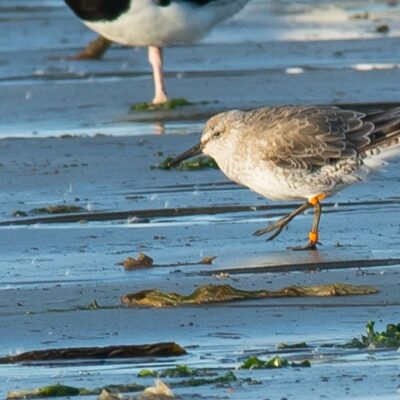
Inspired by Moonbird, these beautifully painted rufa red knots seek pearls of horseshoe crab eggs under the paper sand. This is education at its best.

Interconnection of Species

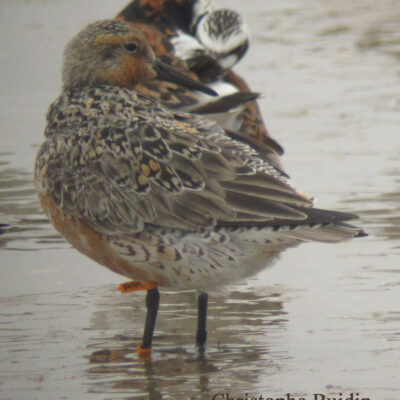
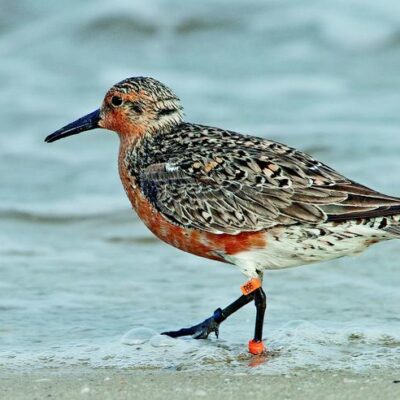
Moonbird Photo by Jan van de Kam

Moonbird Photo by Jan van de Kam

We thank the Children’s Literature and Reading Special Interest Group of the International Reading Association for this review sprinkled with all of our favorite key words and phrases related to Moonbird:

act to make a change,
survival,
conservation,
and interconnection of species.

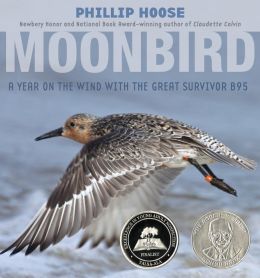
“As he does with every topic he tackles–the ivory-billed woodpecker, civil rights, basketball–Hoose provides interesting details about his topic, and then, provides ways that they can act to make a change. Additionally, the thumbnail sketches of scientists and youngsters who are involved in making sure there is a place for B95 and others of his species answer any questions readers might have as they are reading. Above all, this is a survival story nestled within a story of conservation, one that reminds readers of the interconnection of species…Given the odds against him, how can we not care about the fate of B95 and others like him? Nonfiction doesn’t get better than this.”  –International Reading Association

Library Journal’s Best YA

Thank you to Angelina Benedetti for naming Moonbird to the Library Journal’s Best Books 2012: Young Adult Literature for Adults!

Phillip Hoose has always written his books for young adult and older.  So, it is particularly honor to be named to the best YA for Adults.  And an honor to have such a lovely review from Angelina Benedetti:

“I knew this book as having an impact on me when I caught myself watching shorebirds as I never had before. As he did in The Race To Save the Lord God Bird in 2004, Hoose examines an avian subject in a way that gives the reader new respect. While that book chronicled the tragedy of extinction, in Moonbird, this book uses a single living bird as the lens through which we are introduced to a threatened species. Tagged B95, the “moonbird” is a red knot of the subspecies rufa, a shorebird that annually migrates from South America to the Canadian Arctic; he has flown enough miles in his 20-year lifetime to have gone to the moon and halfway back. His survival is all the more amazing because during his lifetime, his species’ numbers have been reduced by 80 percent owing to human activity. A haunting story of survival against the odds, beautifully illustrated and including profiles of the scientists racing to save this species before it is too late.”

Moonbird, Argentina’s “Project of National Interest”

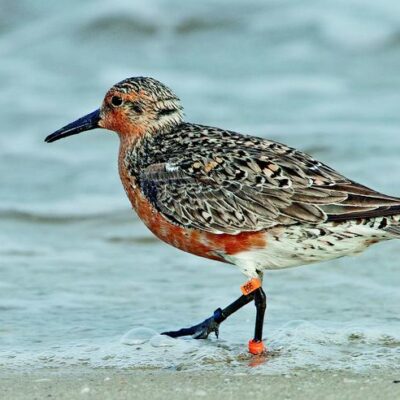
Moonbird Photo by Jan van de Kam

An Argentine Senator has introduced a bill into the national legislature declaring B95—the “Moonbird”– a “project of national interest.  For Senator Jorge Colazo, B95 “symbolizes the importance for the province of the protection of the environment and wildlife

“Today,” he continued,” we honor a symbol of this care—B95, our international ambassador for the continent. The importance of B95 lies beyond his dramatic history. He represents the commitment of our province to environmental care. Over the years we have worked and will continue to do so to protect and preserve our native species, the continuity of their life and reproduction.”

The total mileage accumulated to date in the wings of B95, after many annual migrations between breeding areas of the Canadian Arctic and wintering in South America, is farther than the distance between Earth and the Moon. He can go 8,000 km (5,000 mi) or more without stopping. Nearly 20 years of age, he is the oldest wild rufa Red Knot ever known.  Many places protect red knots, and areas have been recognized internationally for them by the Western Hemisphere Shorebird Reserve Network (WHSRN).

Patricia Gonzalez, the biologist who was part of the team that first banded the amazing bird in Rio Grande in 1995, states that “B95 and other shorebirds are uniting people across the continent. Students from different schools are communicating by Skype. Even if they do not know English, they use translators and manage to communicate.”

B95 was banded in 1995 when he was at least two years old in the Atlantic Coast Reserve, which in 1992 entered WHSRN, by an agreement the Network, when Senator Jorge Colazo was mayor of the city of Rio Grande.
Colazo recalled, “As Charles Duncan, the director of the Executive Office of WHSRN said, ‘I and other colleagues have been working for 20 years on behalf of the wildlife of Tierra del Fuego.’  And I can proudly say today that my daughter, Councilwoman Maria Laura Colazo also defends our wildlife.”

Moonbird in Her Hands

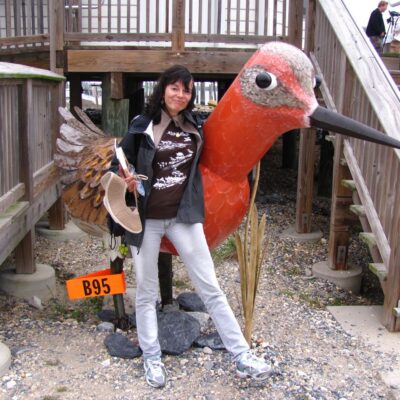
Biologist Patricia Gonzalez and bander of B95 with a statue of B95 on Delaware Bay

“…holding B95 in my hands several times is among the biggest thrills of my life.”
-
-Biologist Patricia Gonzalez

It is only fitting that Biologist Patricia Gonzalez, head of the wetlands program, Fundacion Inalafquen, would be the one to spot B95 last May 28.  She is perhaps the person who knows him best.  She was part of the banding crew who, during a violent hailstorm in Tierra del Fuego way back in 1995, slipped an improvised black band around his lower right leg.

And it was Patricia Gonzalez who, in November, 2001 positioned the orange flag bearing the inscription “B95” to his upper left leg, thus giving him a distinct identity to humans.

And it was Patricia Gonzalez who, in 2007, inserted a thin needle beneath his wing, drawing the small quantity of blood which would determine his gender.

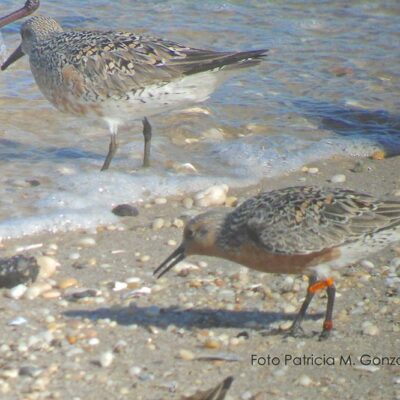
So it is hardly surprising that Patricia Gonzalez would be the one to spot him through a scope and photograph him at Reeds Beach New Jersey, proving that this amazing animal, featured in my book Moonbird, is still with us after a life-span of nearly twenty years. –Phillip Hoose

B95 Photographed by Biologist Patricia Gonzalez on Delaware Bay May 28, 2012